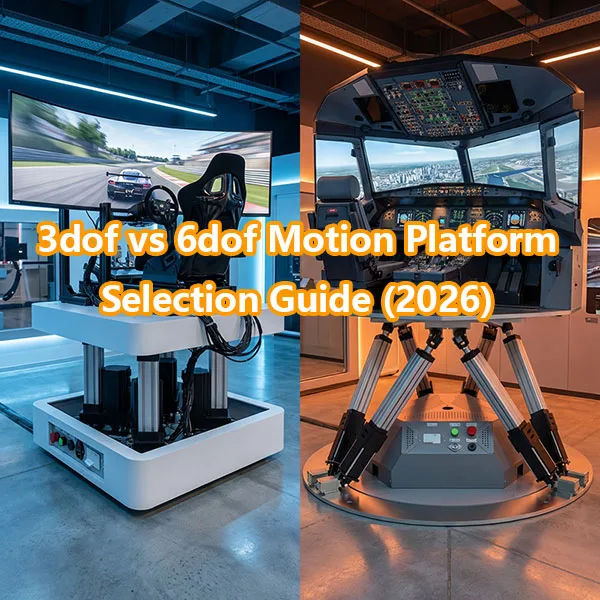
At Allcontroller, we’ve built a lot of motion platform projects over the years. The most common question isn’t “Is your product motion platforms?”
“Do I need 3DOF or 6DOF?”
Honestly, there’s no universal “correct” answer. But behind that question is the one thing you must clarify first:
What outcome does your motion system need to produce—experience, training transfer, or measurable test results?
In simple terms:
3DOF can cover foundational motion perception cues with lower complexity.
6DOF can reproduce more complete 3DOF motion behavior, including key translational accelerations.
For engineers and project owners, the right choice is rarely “more DOF is better.” It’s about finding the best balance between fidelity, complexity, and budget.
In this guide, I’ll explain where people “crash” when they choose wrong, and where 3DOF can be the smarter engineering decision than 6DOF.
Table of Contents
What is DOF (Degrees of Freedom)? Let’s make it crystal clear
What 6DOF means
6DOF = 3 translations (X/Y/Z) + 3 rotations (roll/pitch/yaw).
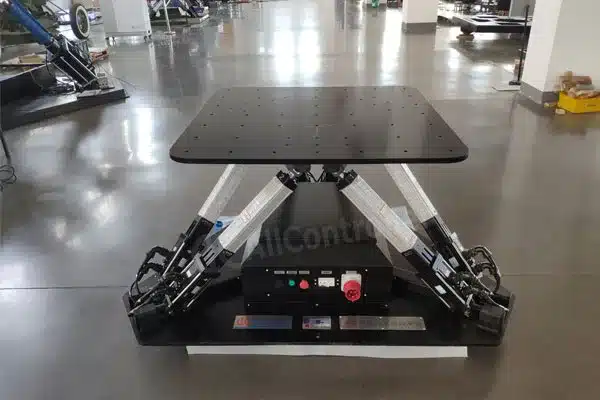
A classic structure for this is the Stewart/Hexapod parallel platform, where six actuators work together to control position and orientation.
What 3DOF means
3DOF is not a “low-end 6DOF.” It’s a platform that provides three chosen degrees of freedom, and in the market it usually appears in two broad patterns:
· Orientation-focused cues: typically based on rotations (and sometimes heave), using tilt to simulate parts of acceleration.
· Translation-focused cues: emphasizing certain linear motions for specific testing or simplified simulation needs.
A quick everyday analogy:
If you sit on a chair and you can nod forward/back (pitch), tilt left/right (roll), and rotate left/right (yaw)—that’s three rotational DOF.
If the chair can also slide forward/back (surge), move left/right (sway), and go up/down (heave)—that adds three translational DOF, making it 6DOF.
3DOF motion platforms: what problem do they solve best?
The core value of 3DOF is this:
With lower system complexity, it delivers the motion cues the human vestibular system is most sensitive to—especially rotational acceleration.
Your inner ear responds strongly to rotational signals. That “thrown into the turn” feeling in racing or flight maneuvers often comes largely from rotation cues. With well-tuned motion cueing, 3DOF can create a very convincing “I’m moving” sensation.
When 3DOF is often the smarter choice
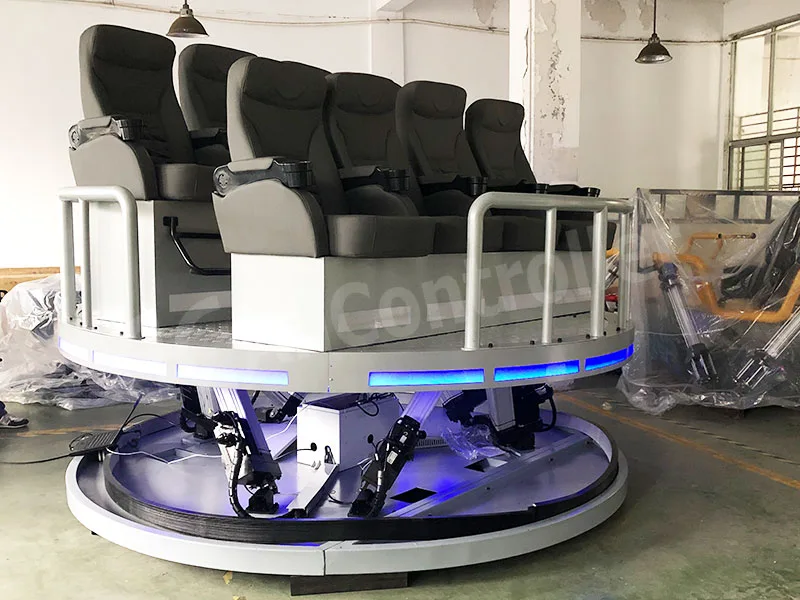
If your project is experience-led (theme parks, VR venues, commercial entertainment, demo/showcase), 3DOF can be the engineering sweet spot because it tends to offer:
Faster deployment: lower mechanical/control complexity, shorter tuning cycles
Simpler maintenance: fewer coupling effects, easier long-term operation
Higher ROI for experience: with tilt coordination, you can deliver clear braking pitch, acceleration lean, and cornering roll that most users instantly “buy”
Typical 3DOF applications
- Commercial entertainment simulators (racing centers, VR experience venues)
- Entry-level flight training (non-certification oriented)
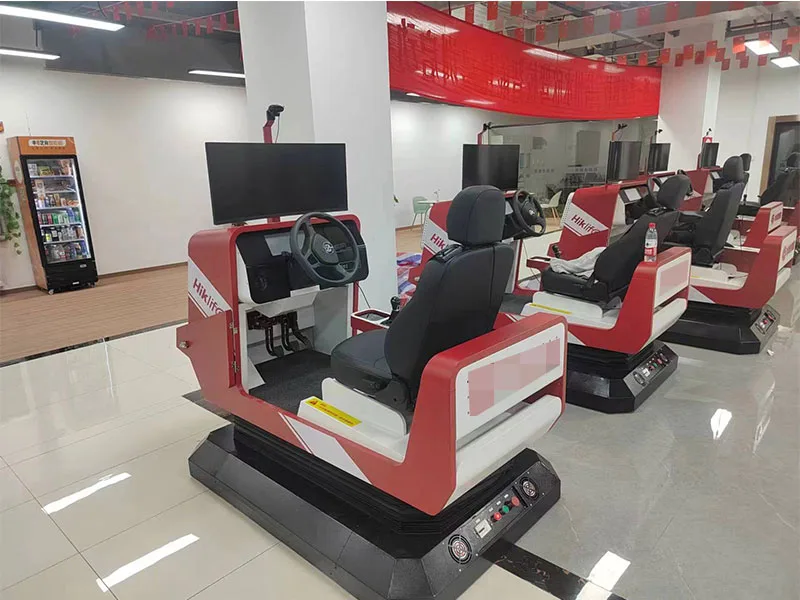
- Educational driving simulators
- Theme park motion rides
- Budget-sensitive training centers
- Sim racing / esports motion seats
The real limitation of 3DOF
I once saw a racing simulator project where the 3DOF platform + steering setup felt great for entertainment.
But when a driving instructor used it for aggressive lane-change drills, he said: “Something’s missing.”
That “missing” part was surge (braking/push-back cues) and sway (true lateral displacement cues)—two axes that are typically 6DOF-only.
For entertainment, that gap might not matter. For professional driver training, it can reduce training transfer and the perceived credibility of the system.
6DOF motion platforms: what do you gain beyond “more axes”?
A 6DOF platform (most commonly a Stewart platform style) uses six actuators in parallel to drive the upper platform. Compared to 3DOF, it adds:
Surge (longitudinal translation)
Sway (lateral translation)
Heave (vertical translation)
What that means in real scenarios
- During aircraft takeoff acceleration, the “push-back” sensation relates to surge.
- In crosswind drift or lateral slip, the body feels sway.
- In touchdown bump or wave impact cues, heave matters.
Certification reality (when 6DOF becomes non-negotiable)
In full-flight simulator contexts, industry references commonly state that FAA FFS Level C and Level D require a motion system with all six degrees of freedom.
Typical 6DOF applications
- Airline pilot training programs targeting higher qualification levels
- Training-grade simulators (consistency, repeatability, evaluation)
- Military vehicle / tactical training simulators
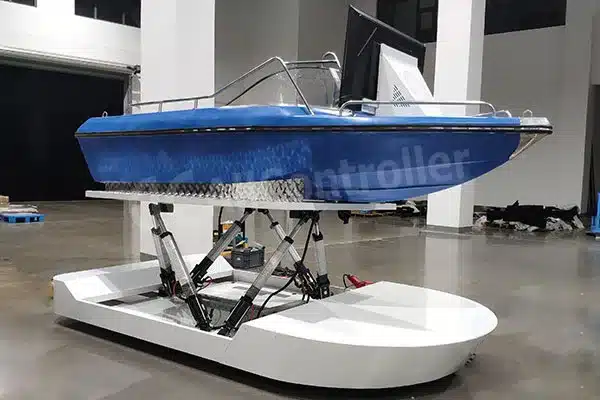
- Ship navigation training and sea-state reproduction
- Automotive chassis/suspension testing, HIL rigs
- Industrial validation and R&D (settling time, repeatability, inertia matching)
- Precision pose control (high-quality motion around a working point)
How I evaluate 3dof vs 6dof with customers
Most “confusion” isn’t technical—it’s because the requirement hasn’t been defined clearly. Here’s what I ask first:
1. Is your primary goal experience or training transfer?
If you want users to say “wow” and keep OPEX manageable, 3DOF often delivers the best ROI.
If you need measurable skill transfer (reaction time, recovery procedures, decision-making under load), you’re aiming for complete vestibular stimulation—6DOF is the engineering foundation.
2. Do you need any industry certification?
This is a hard constraint, not a discussion point. If your product must meet regulated requirements (FAA/EASA or other national frameworks), plan around that from day one.
3. What are your real constraints: budget and space?
3DOF isn’t just cheaper—it’s often lighter, smaller, and faster to install.
For chain venues, mobile demo trucks, or tight classrooms, 3DOF can be the most rational engineering choice.
6DOF Stewart platforms usually need larger base footprint and clearance height. If the site can’t accommodate it, even a generous budget won’t help.
4. What is your payload—and not just total weight?
Customers often ask: “What’s your max load (kg)?”
But what really drives selection is center of gravity and dynamic torque, not just static weight.
A high-CoG cabin produces much larger effective moments under fast pitch/roll. A practical rule of thumb in many real projects is to keep rated load significantly above actual operating load (often ~1.5–2×), depending on duty cycle and dynamic requirements.
5. Which motion cues matter most in your application?
Different scenarios prioritize different cues:
Racing simulator: yaw + sway (oversteer, grip change sensation)
Flight simulator: surge + heave (takeoff/landing, turbulence, push-back)
Marine simulator: heave + sway + roll (sea state, wave impact)
Driver training: pitch + sway + yaw (braking, lane change, stability)
If you only need two or three key axes, a well-configured 3DOF can outperform a poorly configured 6DOF motion platform in real user perception.
Where people choose wrong (the three mistakes I see too often)
Mistake #1: Only comparing “max stroke” or “max angle”
A platform that “moves” is not automatically a platform that “moves well.”
Projects fail because:
it keeps oscillating after reaching target (settling time grows)
performance changes when payload inertia changes (even at same weight)
behavior degrades near workspace boundaries (more common in some parallel systems)
Mistake #2: Ignoring inertia and CoG range
100 kg compact payload ≠ 100 kg long payload with off-center CoG.
That difference can change your control tuning, safety strategy, and mechanical sizing.
Mistake #3: Specifying reachable workspace, not usable workspace
Engineering teams hate “technically reachable but practically unusable.”
You want performance-guaranteed workspace under your typical poses, not edge-case reach.
A quick selection table (3dof vs 6dof)
| What you care about most | Typical recommendation | Why |
|---|---|---|
| Experience, cost, operation & maintenance | 3DOF | Fast deployment, easier maintenance, strong perceived cues |
| Training consistency, evaluation, transfer | 6DOF | More complete cues, better repeatability and acceptance framing |
| Industrial validation / R&D testing | 6DOF (often) | You’ll care more about settling, drift, repeatability, inertia |
| Very large travel requirements | Case-by-case | Sometimes split/combined architectures are more economical |
Allcontroller’s solution viewpoint
We’ve seen too many projects burn months because selection wasn’t clear upfront—then teams end up re-tuning, re-integrating, or even rebuilding the system.
That’s why we believe the core is not only mechanical structure—it’s also control, integration, and verification.
Typical solution layers we provide (configured per project):
Controller layer: coordinated multi-axis control for 3DOF/6DOF, real-time kinematics support (timing depends on system architecture and integration)
Interface layer: commonly supports UDP / CAN / EtherCAT-class integration and connections to simulation software stacks (e.g., DCS, X-Plane, Unreal Engine)
Algorithm layer: configurable motion cueing strategies tuned for different scenarios (amplification, filtering, comfort vs fidelity)
Mechanical layer: payload and actuator sizing based on CoG and dynamic moments—not only static load
And we do not push every customer to 6DOF.
If your use case is commercial entertainment or budget-limited rollout, we’ll tell you plainly: 3DOF motion platform is the better engineering choice.
If you need certification-grade training, high-precision testing, or true multi-axis coordination, we have the engineering depth to support a proper 6DOF delivery.
FAQ (common questions)
What’s the difference between 3DOF and 6DOF motion platforms?
Should I choose 3DOF or 6DOF?
How much more expensive is 6DOF than 3DOF?
Does a flight simulator always require 6DOF?
Can a 3DOF platform include yaw?
What is a Stewart platform in a 6DOF motion platform?
Can motion platforms cause motion sickness?
Selection is a process that requires engineering judgment, not a multiple-choice question with a standard answer. If you are evaluating a motion platform project, feel free to send us your scenario requirements—we are happy to help you analyze it from an engineering perspective, rather than simply selling you a solution.