Introduction: Technological Convergence of Tactile Reproduction and Remote Manipulation
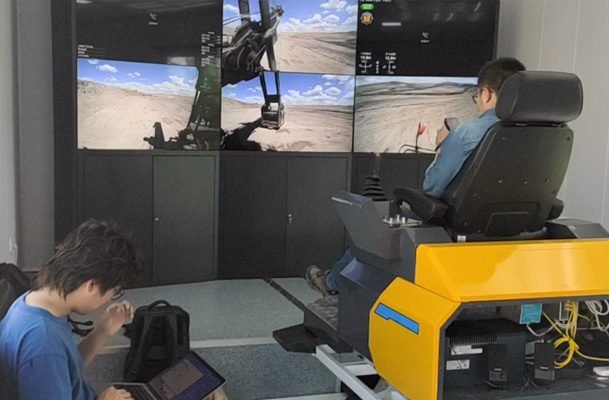
Supported by 5G low-latency, high-bandwidth communications, remote driving is moving from the laboratory to complex operational scenarios such as mines and construction sites. However, traditional remote control relies only on visual information feedback, and the operator is unable to perceive physical environments such as vehicle bumps and mechanical arm reaction forces, resulting in low operational accuracy and high equipment loss. The six-degree-of-freedom motion platform, through parallel mechanical structures (such as the Stewart platform) and real-time positional feedback, transforms the motion and vibration of the remote vehicle into the tactile perception of the local cockpit, and builds a multi-dimensional interactive closed loop of “vision + force + kinaesthesia”. This technological breakthrough enables remote driving to realize millimeter-level operation precision and millisecond response speed in special scenarios such as unmanned mining vehicles and deep-sea exploration vehicles.
System Composition: Four Core Modules for Cross-Space Dynamic Sensing
1、Hardware layer of 6dof motion platform
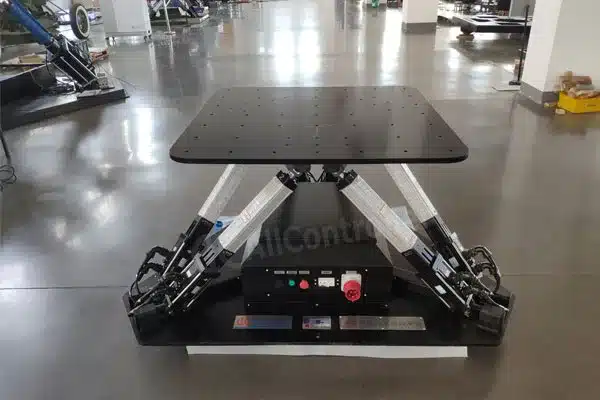
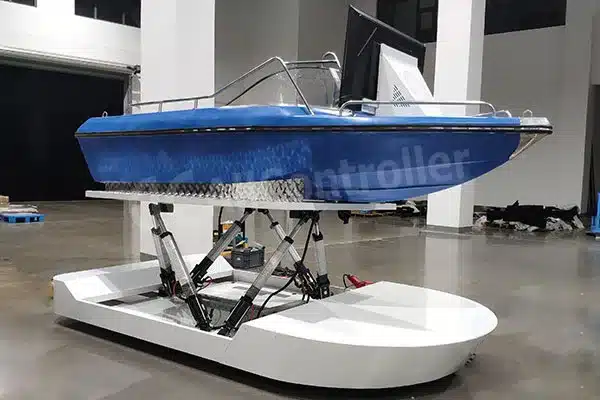
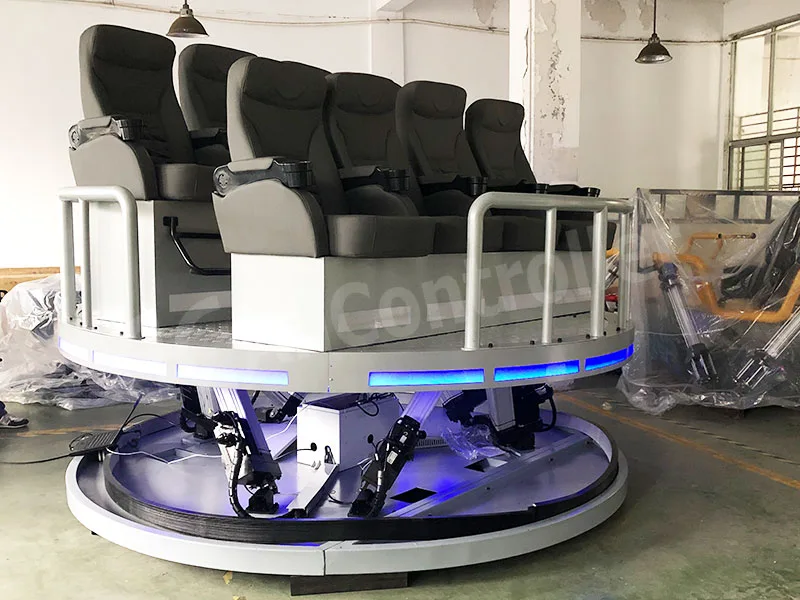
Adopting parallel structure (6 electric cylinders supporting the upper platform), with X/Y/Z axis translation and pitch/roll/yaw rotation capabilities, load customized according to requirements, from 100KG to 5 tons can be customized, integrated high-precision encoders and force sensors, real-time acquisition of remote vehicle attitude data and drive the local platform to reproduce the vibration, tilt and other dynamic features.
2、5G communication and edge computing layer
5G URLLC (ultra-reliable low-latency communication) is used to transmit data such as vehicle position and mechanical arm force, and edge computing nodes are deployed with an end-to-end latency of <20ms to predictively compensate for the motion trajectory of the six-degree-of-freedom platform and reduce the impact of network jitter on the continuity of the maneuver.
3、Human-machine interaction perception layer
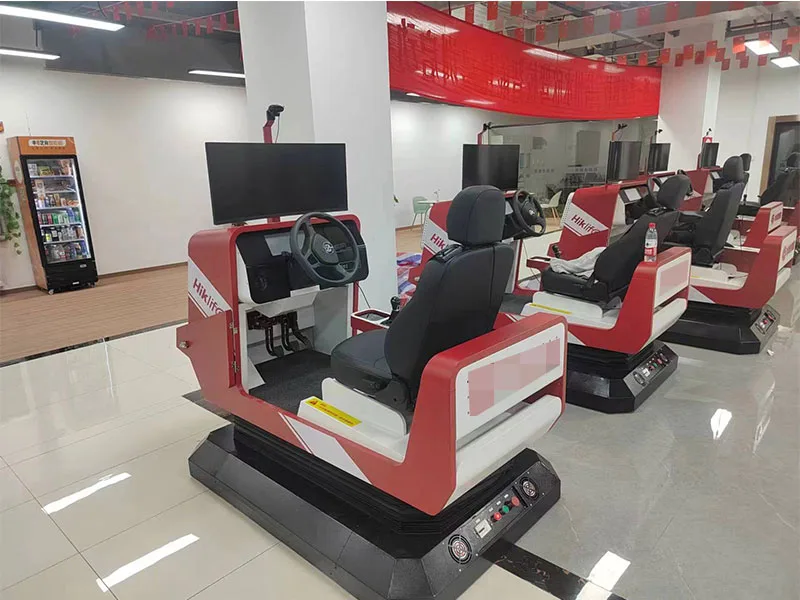
The cockpit is equipped with force feedback steering wheel and multi-axis pedals, combined with the six-degree-of-freedom platform motion simulation excavator bucket bottoming recoil, mining truck brake inertia and other physical feedback VR helmet to achieve a 360 ° panoramic video synchronized with the platform motion, eliminating the visual-body sensory mismatch caused by the feeling of vertigo.
4、Safety control and fault redundancy system
Dual redundant CAN bus ensures that the six degrees of freedom platform is synchronized with the remote vehicle control instructions, and automatically switches to the preset safety mode when the communication is interrupted Vibration amplitude overrun protection module real-time monitoring of the motorized cylinder stroke, preventing mechanical damage caused by overload.
Three breakthroughs in working in high-risk environments
Safe driving of unmanned underground mining vehicles
The 6dof platform reproduces the mine cave-in warning vibration, the ore hauler climbing incline (slope ≤ 35°), and the operator can prejudge the risk of vehicle skidding through the sense of body, which reduces the rollover accident by 50%.
Combined with LIDAR point cloud data, it simulates the impact force of ore hitting the mechanical arm during shoveling operation, and improves the loading efficiency by 30%.
Precise control of remote construction machinery
In high-risk scenarios such as the demolition of nuclear power plants, the six-degree-of-freedom platform synchronously simulates the fluctuation of the reaction force of the hydraulic breaker hammer (±200N), avoiding overloading of the equipment due to the lack of tactile sensation; the tilt angle of the platform is the same as that of the excavator boom.
The tilt angle of the platform is linked with the extension of the excavator boom, so that the operator can sense the trend of the center of gravity shift and reduce the risk of tipping.
Cross-media operation of deep sea/polar exploration vehicle
Simulate the transverse rocking motion (amplitude ±15°) of the underwater 3000m exploration vehicle impacted by ocean currents, and assist the operator in adjusting the thruster power through haptic feedback.
When working on the polar ice surface, the platform synchronously reproduces the instantaneous acceleration (0.5g) generated by the ice rupture to improve the emergency braking response speed.
In the future, with the evolution of 6G passive integration and AI digital twin technology, the six-degree-of-freedom platform will break through the geographical boundaries, and become the core interactive interface in the fields of intelligent mining and deep space exploration, etc. These technological fusion systems will completely break the limitations of the physical space on high-risk operations, enabling humans to manipulate complex equipment thousands of miles away in a zero-risk environment, reshaping the boundaries and efficiency of industrial production. The six-degree-of-freedom motion machine that we produce will be the first of its kind. The six-degree-of-freedom motion platforms we produce will also promote the scientific research and development of these industrial applications, and we hope that we will be able to realize these scenarios in the near future.