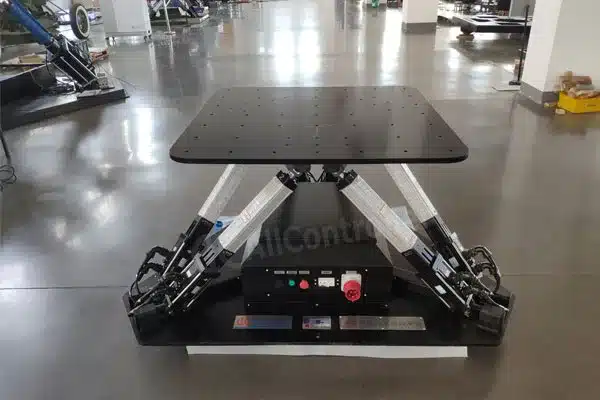
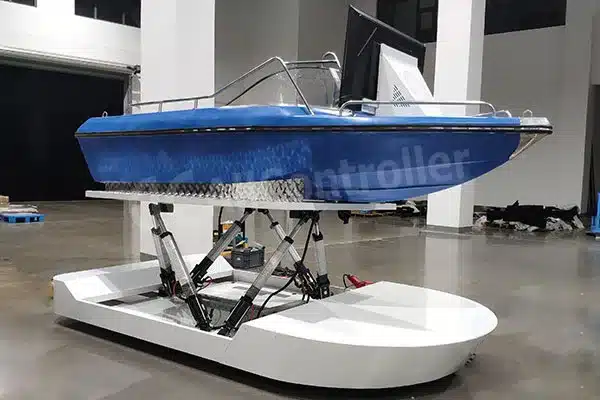
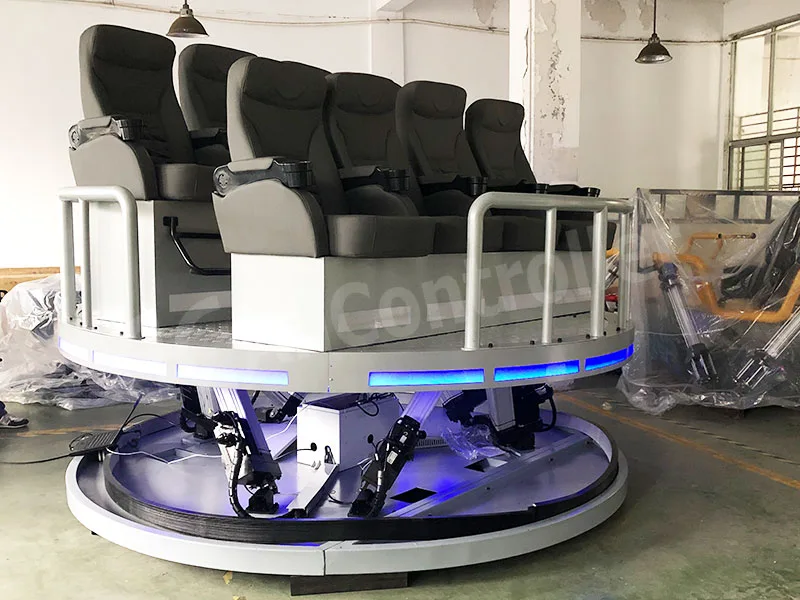
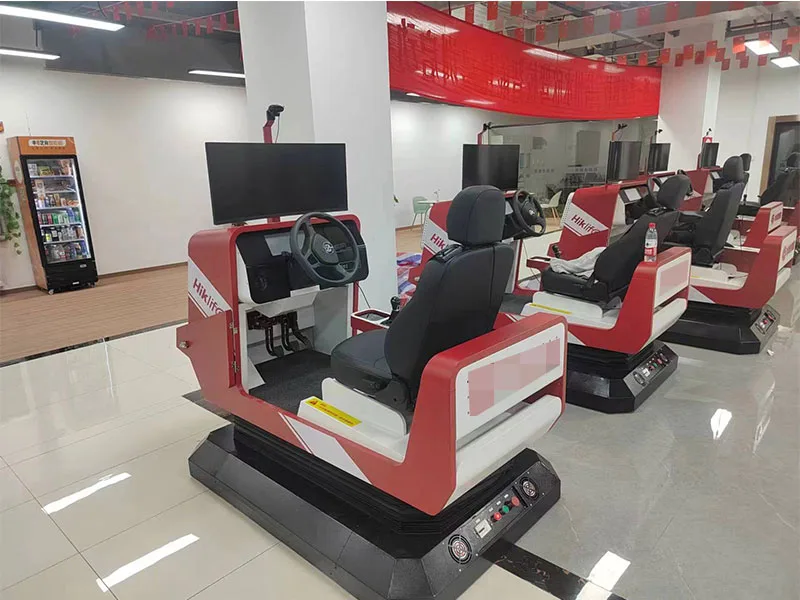
Since its introduction in 1965, the Stewart Platform has become a core tool in industrial testing fields such as aerospace, automobile manufacturing, and medical surgery, thanks to its unique six-degree-of-freedom (6-DOF) parallel structure and millimeter-level precision control capabilities.
It uses six independently controlled linear drives (servo electric cylinders) to achieve translation and rotational movement of the upper platform in three-dimensional space, breaking through the accuracy bottleneck of traditional serial robotic arms.
As pioneers in Stewart platform manufacturing, Allcontroller delivers cutting-edge six-degree-of-freedom (6DOF) motion systems that redefine accuracy in industrial testing. Our high-precision Stewart platforms enable realistic simulation of complex spatial movements, making them indispensable for quality validation across industries.
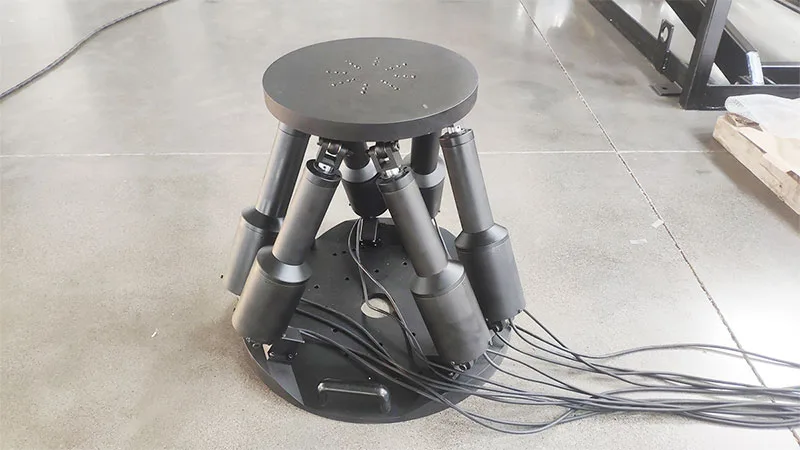
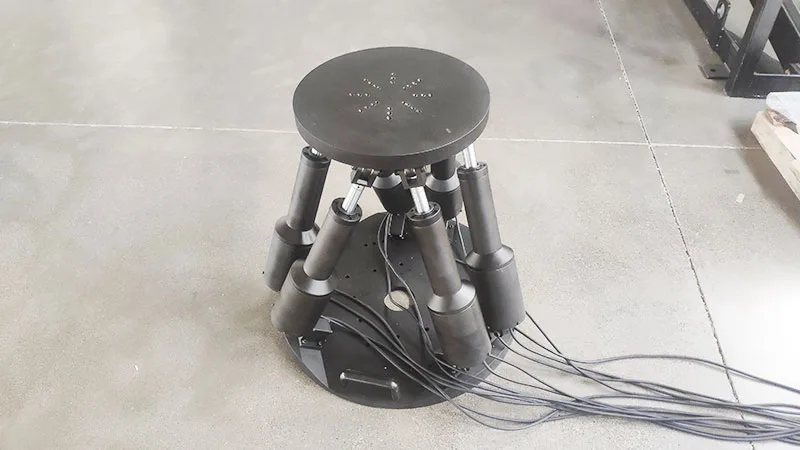
Modern Stewart platform industrial testing solutions provide
- 6DOF Motion Control: Synchronized X/Y/Z translation + roll/pitch/yaw rotation
- Millimeter Precision: ≤0.1mm positioning accuracy for critical tests
- 500kg+ Payload Capacity: Robust construction for heavy-duty applications
- Custom Waveform Generation: Sine, random & user-defined motion profiles
Key Applications in Industrial Testing
Space and Satellite Testing
The Stewart platform simulates the microgravity environment of space and is used to verify the reliability of satellite docking mechanisms. For example, a laser tracker can be used to match the preset path in real time to achieve space docking experiments with millimeter-level accuracy. Similarly, such docking experiments and tests can also be implemented in the industrial field.
Automobile manufacturing and safety testing
Crash simulation: reproduce the six-degree-of-freedom motion of the vehicle during rollover and collision, and verify the airbag triggering logic.
NVH test: car companies can use electric servo drive platforms to simulate road vibration and conduct noise analysis error experiments.
Medical robotic surgery equipment
The Stewart platform, coupled with an optical navigation system, enables sub-millimeter tracking of surgical instruments.
Structural Engineering Simulation Experiment
It can be applied to scenarios such as earthquake simulator testing, bridge/wind turbine resonance analysis, and material vibration life prediction.
In the future, with the application of quantum sensors and new materials, the Stewart platform may achieve nano-level motion control and usher in the “ultra-precision era” of industrial testing. The Allcontroller team will continue to innovate and invest more in research and development to create more application scenarios for the Stewart platform in industrial testing.