Executive Summary
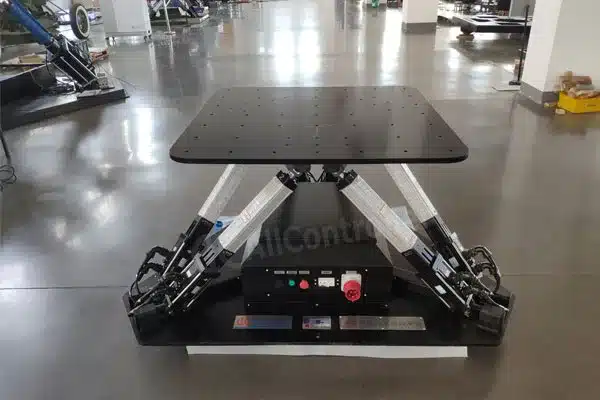
3 DOF motion platform is a motion system that generates three controlled axes of movement—most commonly pitch + roll + heave (vertical)—to reproduce repeatable test motion under load for validation and R&D work.
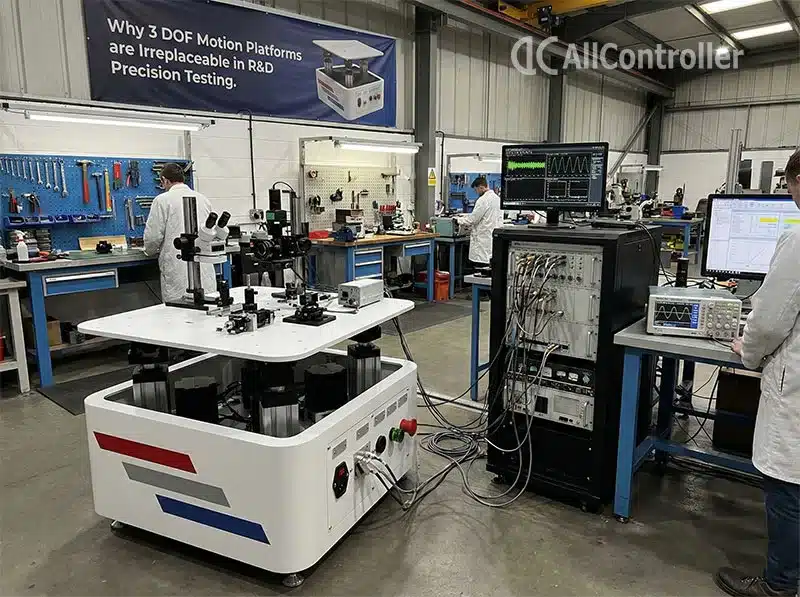
If you’ve only seen 3 DOF Motion Platform in simulators, it’s easy to underestimate it. In R&D testing, I’ve found 3DOF sits in a sweet spot: it’s simple enough to be stable and repeatable, but dynamic enough to expose real failure modes that a fixed rig will never show.
While the industry often gravitates toward the complexity of 6-axis systems, the 3 DOF platform remains the “silent workhorse” of the laboratory. It offers a unique balance of structural rigidity, low noise floors, and high-frequency response that is often unattainable in more complex kinematic chains. For engineers focused on repeatable data rather than just “moving a seat,” understanding the nuances of 3 DOF systems is the difference between a successful validation and a failed experiment.(Explore our full lineup of 3DOF motion platform)
Table of Contents
The real problem R&D teams are trying to solve (and why 3 DOF Motion Platform fits)
When engineers search “3 dof motion platform” for R&D/testing, they’re usually not chasing “immersion.” They’re trying to answer questions like:
Will this payload survive motion + load direction changes repeatedly?
Can we reproduce the exact same input motion tomorrow, next week, and after design changes?
Are we testing the product… or accidentally testing the test rig?
When we design a 3 DOF platform for R&D, we focus on stiffness. By reducing the degrees of freedom to the essential Pitch, Roll, and Heave, we create a much more stable “Ground Truth.” To put it simply: if your test requires 0.01° of angular precision, it is much easier (and more reliable) to achieve that on a 3-point support system than a 6-point one.
What “3 DOF Motion Platform” means in daily life terms
Engineers talk about DOF like it’s obvious, but procurement and cross-functional teams often get stuck here.
Pitch / Roll: imagine you’re tilting a tray forward-back or left-right.
Heave (Z): imagine an elevator motion straight up/down.
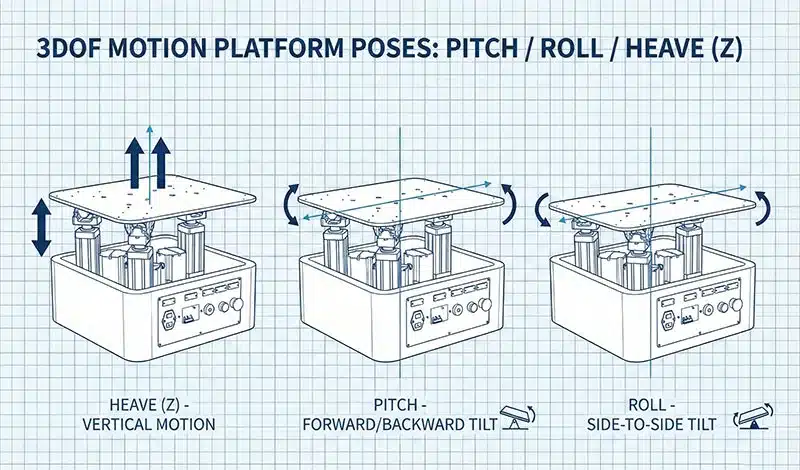
(Some 3DOF variants use yaw instead of heave, but in R&D rigs, pitch/roll/heave is a common pattern because it’s great at creating gravity-vector changes and vertical excitation.)
Why 3 DOF motion platform can be “more precise” than 6DOF in certain tests
Here’s a truth that surprises people: more axes can make your test less trustworthy if your goal is clean, repeatable data.
In a 6DOF system, you’re controlling more coupled dynamics (more ways for the structure and control loops to interact). A well-built 6DOF is amazing—but if your test requirement doesn’t need yaw/surge/sway, you may end up paying (in cost and time) for complexity that doesn’t improve your confidence.
3 DOF motion platform is often the “minimum sufficient motion” for:
attitude disturbance replication (pitch/roll)
vertical excitation (heave)
gravity-vector changes that expose connector fatigue, fluid slosh issues, sensor alignment drift, and mount loosening
This is why many vendors position 3 DOF motion platform as a pragmatic alternative when 6DOF isn’t required.
The Technical Core: What Makes a Platform "R&D Grade"?
When you look at a spec sheet, every manufacturer lists “Payload” and “Velocity.” But in a factory-level technical review, those aren’t the numbers that keep me up at night. I look at:
Latency & Sync (The Brain): For R&D, the motion controller must talk to your data acquisition system in real-time. If the platform moves but the signal lags by 20ms, your sensor calibration data is worthless.
The Servo Loop: We use high-end AC Servo systems. Think of the servo motor as the “muscle” and the encoder as the “nerve endings.” High-resolution encoders (23-bit or higher) allow the platform to make micro-adjustments that you can’t even see with the naked eye but your sensors will definitely feel.
Mechanical Rigidity: In 3 DOF systems, we often use a “Tripod” or “Crank” structure. This provides a clear, mathematical center of rotation. In my experience, a well-built 3 DOF platform has a much higher natural frequency, meaning it won’t vibrate uncontrollably when you try to simulate high-frequency road noise or engine tremors.
The engineering reasons 3 DOF motion platform becomes “irreplaceable” in precision testing
Stiffness and “signal purity”
In R&D tests, the platform must not become the dominant spring/damper in your system. Parallel/compact motion mechanisms are often valued because they can be stiff for their footprint, which helps the motion you command look like the motion your payload receives. (This “stiffness-per-size” argument is widely cited for parallel motion concepts in general.)
Life version: you don’t want your test rig to feel like a trampoline.
Repeatability beats “big motion”
A lot of tests don’t need huge angles or long stroke. They need:
stable closed-loop control
low drift
consistent phase response (so time alignment stays valid)
That’s why you’ll see “real-time control” and “motion feedback” called out as core features for 3 DOF motion platform that target testing/R&D.
Fixtures, payload interfaces, and the boring stuff that decides success
From a factory perspective, the “platform” isn’t just actuators. The real project is usually:
top plate interface (bolt patterns, dowel pins, quick swap)
cable management + strain relief
safety stops + limit strategy
payload CG uncertainty (and how we keep stability anyway)
Most product pages mention “customizable” for a reason—mounting and integration is where schedules slip.
A common selection mistake I’ve seen (and it causes test data arguments)
To avoid over-investing or under-speccing, evaluate these core pillars before purchasing your Professional 6DOF Motion Platform:
One of the most common “selection flip points” is this:
People choose by payload (kg) first, and only later realize bandwidth and CG matter more.
In real R&D testing, two payloads with the same mass can behave totally differently:
Payload A: compact, CG centered, stiff
Payload B: tall, CG high, flexible harnessing
Same kilograms, totally different control difficulty and safety margin.
If you’re buying a 3 DOF motion platform for precision testing, I usually push teams to define payload CG envelope and required motion frequency content early, not as an afterthought.
How I’d choose a 3 DOF motion platform for R&D testing
Start from the test profile, not the platform catalog
Define:
motion type: pitch/roll/heave (or your required 3 axes)
required amplitude range (typical / worst-case)
frequency content (what you must reproduce reliably)
Many suppliers position 3 DOF motion platform for “training, testing, research,” but your R&D profile is the thing that determines actuator sizing, control strategy, and thermal design.
Decide electric vs hydraulic based on what you’re actually optimizing
Electric (servo / electromechanical) tends to win when you care about cleaner control, easier integration, and lab-friendly maintenance.
Hydraulic tends to win when you need high force density and aggressive dynamic performance—but you accept the hydraulic ecosystem (power unit, fluid management, noise, maintenance).
I’m not saying one is “better.” I’m saying the wrong one will quietly dominate your total cost of ownership.
Don’t ignore how the control loop will be validated
For precision testing, you want a plan for:
reference input definition (time history / PSD / sine sweep)
measurement strategy (platform feedback + payload-mounted sensors)
correlation and repeatability checks
That’s how you avoid the “platform says it did X, payload says it felt Y” blame game.
Typical Scenarios: Where We See the Most Success
I often tell clients that if their project falls into these three buckets, 3 DOF isn’t just a “cheaper option”—it’s actually the better technical choice:
Automotive Sensor Calibration: Calibrating IMUs (Inertial Measurement Units) or ADAS cameras. You need steady, repeatable tilts and vertical heaves to simulate road grades and speed bumps without the “parasitic” movements of a 6-axis system.
Liquid & Sloshing Tests: Testing fuel tanks or medical containers. Here, the priority is sustained, controlled angles (Pitch/Roll) to observe fluid behavior under G-force.
Durability & Fatigue Testing: Running a cycle 100,000 times. A 3 DOF system has fewer moving parts and points of failure, meaning your test rig won’t break before your product does.
Quick FAQ
What is a 3 DOF motion platform used for in R&D testing?
It reproduces repeatable multi-axis motion (often pitch/roll/heave) so you can validate durability, sensor performance, and structural integrity under controlled dynamic inputs.
Is 3DOF enough, or do I need a 6DOF motion platform?
If your test objectives don’t require yaw/surge/sway, a well-designed 3DOF can give cleaner, more repeatable data with less integration complexity. Many suppliers explicitly position 3DOF as the practical alternative when full 6DOF isn’t necessary.
What specifications matter most for precision testing?
Payload CG envelope, dynamic bandwidth, repeatability, control feedback quality, and fixture/interface design usually matter more than “payload kg” alone. (Vendor pages often highlight customization and feedback control because integration and loop quality decide outcomes.)
Electric vs hydraulic: which is better for lab testing?
Electric servo platforms are often preferred for lab environments due to integration and maintenance simplicity; hydraulic platforms can excel in force density and aggressive dynamics but add system overhead. Your decision should match the test profile and operating constraints.
I’ve seen many projects fail because they bought the most expensive equipment rather than the most stable equipment. In the lab, precision isn’t about how many directions you can move—it’s about how well you can control the directions that matter.
If you want, share what you’re testing (sensor/structure/electronics?) and the rough motion profile you’re trying to replicate—I can tell you where 3 DOF motion platform is genuinely the best tool, and where teams usually regret not going 6DOF.
“…For many commercial R&D simulations, 3 DOF is more than enough. If you have specific load or stroke requirements, we also offer customized motion system designs to fit your unique testing rig.”