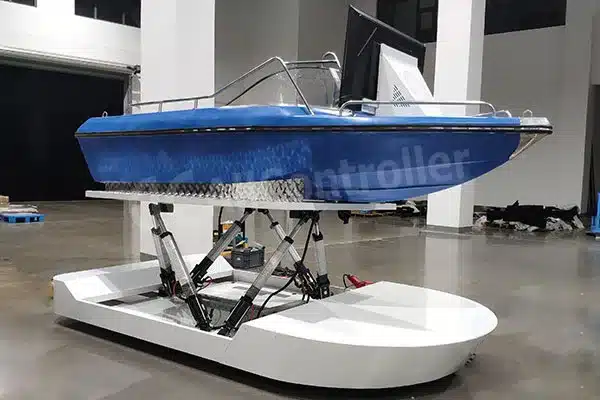
Nowadays, the application of UAV is very wide, especially in the sea rescue, monitoring and other scenarios play a big role. However, under the influence of the sea environment, when executing UAV recovery, equipment placement or personnel transfer, the swaying of traditional ships may lead to equipment damage or even mission failure.Allcontroller has developed a self-balancing motion platform at sea, which provides a revolutionary solution for marine operations by collecting wave data in real time and dynamically compensating for it, so that the top of the platform is always in a horizontal state.
Core Technology Principles
1, Stewart platform parallel connection mechanism design
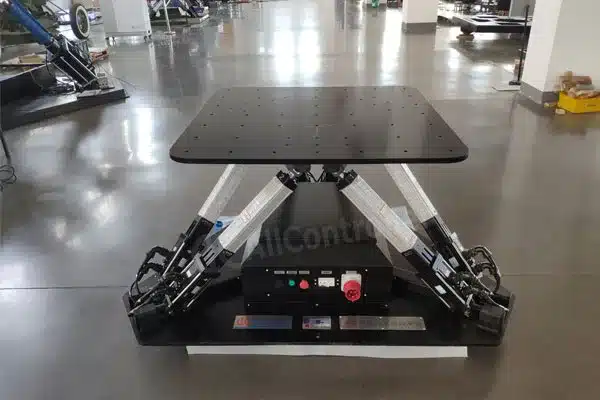
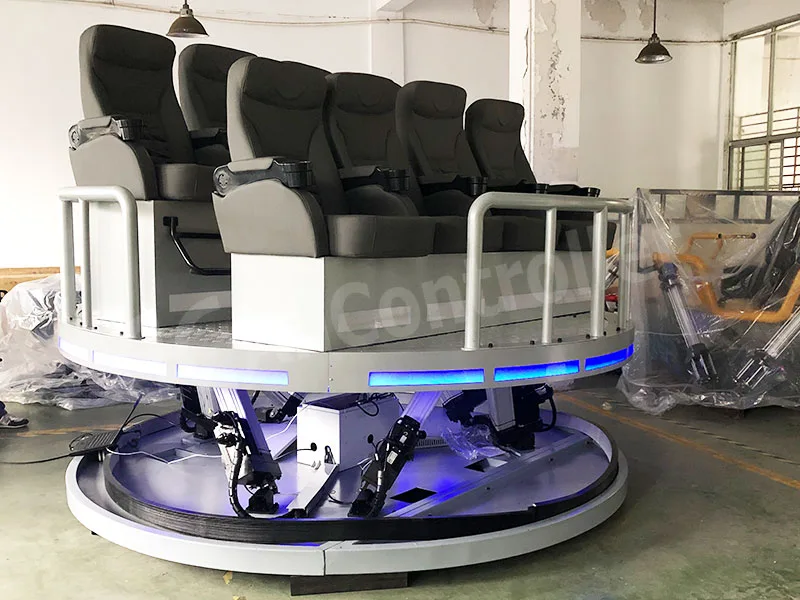
Based on the structure of Stewart platform, six servo cylinders (electric or hydraulic cylinders) are connected in parallel to the upper and lower platforms to form a rigid closed-loop system. Each servo cylinder is connected to the platform through a universal hinge and independently extends and retracts to change the length, which collaboratively realizes the platform’s six degrees of freedom of movement in three-dimensional space (X/Y/Z translation, rotation around the X/Y/Z axis).
2、Kinematics solving algorithm
Positive kinematics: Calculate the platform attitude (position and angle) in real time according to the expansion and contraction amount of servo cylinders.
Inverse kinematics: inversely deduce the expansion and contraction demand of each servo cylinder according to the target position, and solve the problem by matrix transformation or geometric modeling.
3、High precision control algorithm
Adopt fuzzy PID control, adaptive control or model predictive control (MPC), combined with the drive system of servo electric cylinder, real-time adjustment of the output force and speed, to realize the compensation accuracy within ±0.5°.
4、Multi-sensor fusion feedback
Inertial Navigation System (INS): monitoring the real-time attitude of the platform;
Laser distance measurement/encoder: detect servo cylinder displacement; and
Force Sensor: Feedback load change, realize dynamic compensation.
Realization process
The realization process of six-degree-of-freedom motion compensation begins with real-time acquisition of wave displacement and attitude data by inertial navigation system (INS) and wave radar, combined with external commands (e.g., landing trajectory of the drone or stabilization requirements of the trestle bridge between the two ships) to resolve the target position parameters; the target position is then converted to the expansion and contraction commands of the six servo cylinders using inverse kinematic algorithms, and the motion parameters are solved for the cylinders through matrix transformation or geometric modeling. The hydraulic or electric driven servo cylinders work together to expand and contract according to the commands, for example, the Z-axis cylinder quickly adjusts the vertical displacement to compensate for the lifting and sinking motion, while the X/Y-axis cylinder works together to inhibit the transverse and longitudinal rocking; in the closed-loop control system, the displacement sensors, force sensors, and the INS feedback the platform’s actual position in real time, and dynamically correct the servo cylinder actions through the fuzzy PID or model predictive control (MPC) algorithms to form a millimeter-level precision motion compensation, which ultimately makes the target position more precise, and the motion compensation is more accurate. Through the fuzzy PID or model predictive control (MPC) algorithm, the servo cylinder action is dynamically corrected to form millimeter-level precision motion compensation, which ultimately makes the platform maintain dynamic balance under complex sea conditions.
Application Scenarios
1、Safe transfer of personnel and materials (trestle stabilization system)
Through real-time compensation of transverse, longitudinal and lifting and sinking motions of the ship triggered by waves, it ensures the stable passage of the trestle bridge between the two ships and reduces the risk of collision in the process of personnel transfer and material replenishment.
2、UAV precision landing and shipboard equipment stabilization (UAV sea landing compensation)
Provide a dynamic balance platform for UAV take-off and landing on the deck of the ship, offsetting the vertical displacement through Z-axis rapid expansion and contraction to ensure the landing accuracy; meanwhile, stabilize the shipborne communication equipment, weapon targeting system and other key devices.
3、Ocean research and engineering testing
Simulate the real wave environment, support the wave resistance performance test of marine equipment (e.g. underwater robots, sonar equipment), reduce the data collection error; optimize the hull structure design, improve the ship’s wave resistance and stability.
4、Emergency training for extreme sea conditions
Simulate the ship out of control, yawing and other unexpected conditions, assist the crew to carry out emergency operation training, enhance the ability to respond to the scene under complex sea conditions and operational safety.
With the rapid development of the marine economy and the increasing demand for safety and efficiency in offshore operations, Allcontroller’s self-balancing offshore platforms are revolutionizing the fields of drone landing at sea, inter-vessel material transfer, and marine research equipment delivery, thanks to their outstanding performance and safe and reliable quality. In the future, we will continue to deepen our technological innovation to provide our global customers with smarter and more reliable offshore operation solutions, and help the unlimited possibilities of ocean exploration and development.