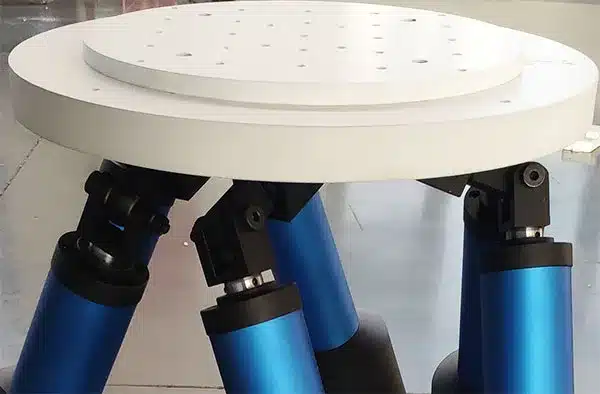
In today’s highly competitive industrial landscape, positioning accuracy is a non-negotiable requirement across manufacturing, quality control, and scientific research. Traditional testing and calibration methods often fall short when faced with multi-axis motion or complex dynamic conditions. Enter the Stewart Platform for Industrial Testing, a revolutionary tool that provides an unparalleled solution for achieving extreme accuracy and versatility in industrial metrology.
With its unique 6DOF parallel structure, the Stewart platform offers a robust and flexible solution for validating the performance of industrial equipment and precision components. This article will delve into how our Stewart platforms, like the ones designed and manufactured by Allcontroller, significantly elevate precision testing, explore their core advantages and key applications, and provide critical considerations for platform selection.
Understanding the Stewart Platform for Industrial Testing
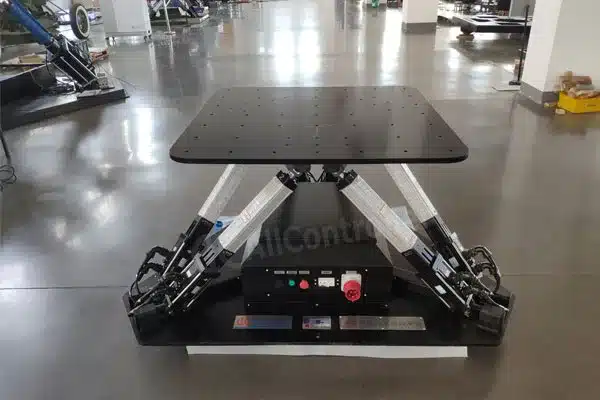
At its core, a Stewart platform is a high-precision motion control platform composed of six actuators arranged in a parallel configuration. These actuators are connected via universal or ball joints, linking an upper movable platform to a lower fixed base. This parallel kinematic structure provides exceptional stiffness and stability, effectively resisting external loads and disturbances.
The Stewart Platform for Industrial Testing overall rigidity and performance are determined by its geometric configuration and the materials used in its construction. These design parameters are carefully optimized to meet specific application requirements, ensuring the platform’s shape and materials are perfectly adapted to the intended task.
Allcontroller Stewart platforms offer high-precision motion control and positioning with six degrees of freedom (X, Y, Z translation and Rx, Ry, Rz rotation). This ability to flexibly and accurately achieve any target position and orientation within its workspace is a cornerstone of its application in industrial testing.
Unrivaled Performance in Metrology and Precision Testing
The Stewart Platform for Industrial Testing exceptional performance in metrology stems from its unique design and structural characteristics:
Coordinated Positioning: A key advantage is its ability to precisely control all six motion axes simultaneously. This enables the platform to accurately position a test object or sensor, providing a foundation for comprehensive, full-coverage precision testing.
Accuracy & Repeatability: The parallel structure provides significantly higher stiffness compared to traditional serial manipulators, boosting positioning accuracy and minimizing accumulated errors. This precision is guaranteed by high-end electric (or hydraulic) cylinders and sophisticated closed-loop control algorithms, ensuring that every motion command is executed and repeated with consistent accuracy.
High Stiffness & Load Capacity: The parallel structure also gives the platform extremely high stiffness. This guarantees the integrity of test results by minimizing errors and preventing platform deflection caused by inertial forces, even when carrying heavy industrial components or test equipment.
Dynamic Motion Simulation: The platform can precisely replicate complex motion trajectories, generating critical data to evaluate the performance of equipment or components under real-world dynamic conditions.
Open Architecture & High Adaptability: The open-platform design is crucial for its versatility. The upper and lower platforms provide a solid base for mounting various precision sensors (e.g., laser trackers, CMM probes, optical encoders) and customized test fixtures, significantly enhancing system flexibility.
These five core advantages—coordinated positioning, precision and repeatability, superior stiffness, dynamic simulation, and high adaptability—make the Stewart Platform for Industrial Testing an essential solution for modern industrial metrology and testing.
Stewart Platform for Industrial Testing Key Applications in Industrial Metrology and Testing
The high precision, stiffness, and dynamic performance of the Stewart Platform for Industrial Testing make it an invaluable tool across various industrial applications:
Sensor Calibration: The platform can drive sensors along predefined, precise paths to dynamically record measurement errors, providing data for software compensation and evaluating performance limits. This is ideal for calibrating laser scanners, optical sensors, and CMM probes.
Component Alignment: For critical components in aerospace, optics, or robotics, the platform can precisely position parts under simulated loads to verify position and alignment with extreme accuracy, from the manufacturing process to final inspection.
Robot Calibration: By precisely measuring the deviation between a robot’s commanded and actual end-effector path, the Stewart platform can quantify motion errors, providing crucial data for error compensation algorithms and performance verification.
Multi-Axis Machine Tool Calibration: When equipped with metrology tools like a laser tracker, the platform can move throughout a machine tool’s workspace to measure and record spatial errors, building a comprehensive error model for machine correction.
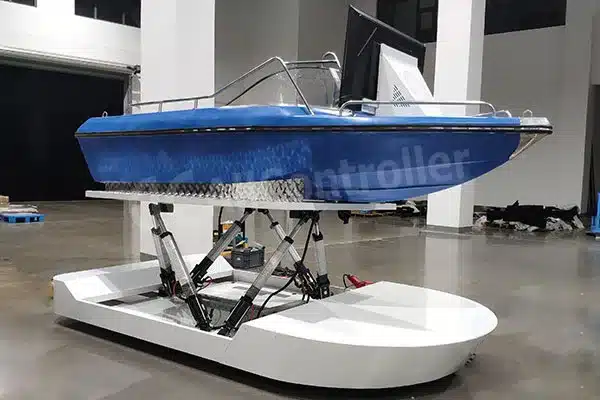
Dynamic Simulation: The platform can simulate extreme environments like earthquakes for testing the response of bridges and buildings, or reproduce complex sea conditions for marine equipment testing.
Choosing the Right Stewart Platform for Your Needs
Selecting the right Stewart Platform for Industrial Testing is crucial for the feasibility of your experiments and the reliability of your data. To ensure a perfect match, consider the following key parameters:
Payload Capacity: Determine the total weight of your test object to ensure the platform can handle both static and dynamic loads.
Motion Range: Define the required maximum displacement and rotation angles. Stewart platforms are ideal for scenarios demanding large angular adjustments and precise positioning in a confined space.
Accuracy & Resolution: Focus on the platform’s positioning accuracy, repeatability, and motion resolution. Verify the manufacturer’s performance data to ensure it meets your specific testing requirements.
Control System & Software Integration: Prioritize platforms with an open API for seamless integration with your existing software, simulation environments, or automated workflows.
Customization Capabilities: Assess the manufacturer’s ability to create custom solutions for non-standard applications, including unique sizes, extreme loads, or specific motion trajectories.
Manufacturer Support: Partner with a company that offers strong technical expertise and comprehensive support, from installation and training to fast issue resolution and long-term maintenance.
Allcontroller is committed to providing superior Stewart platform and expert support, ensuring your equipment runs reliably and your investment is protected for years to come.
Conclusion: The Future of Precision Testing
The Stewart platform, with its exceptional performance and wide-ranging adaptability, has become a cornerstone of modern industrial metrology and testing. Driven by the advancements in smart manufacturing and Industry 4.0, our technology has evolved to meet the most demanding engineering challenges.
Allcontroller is dedicated to this innovation. With a professional R&D team and extensive customization capabilities, we stand ready to collaborate with you to solve your most complex engineering problems.