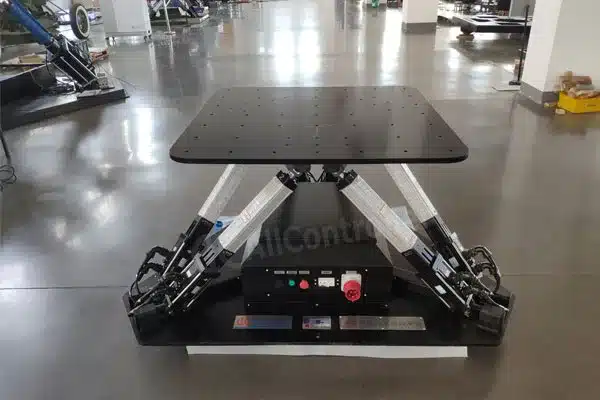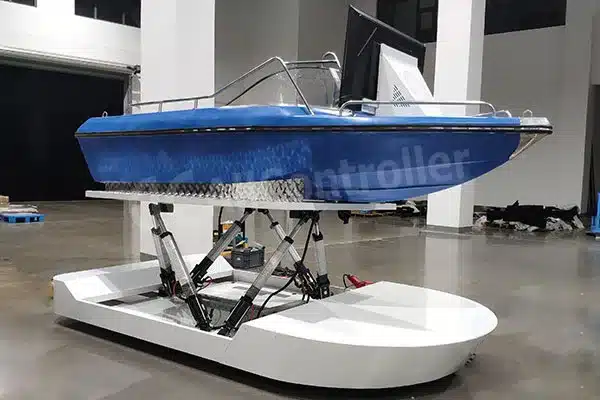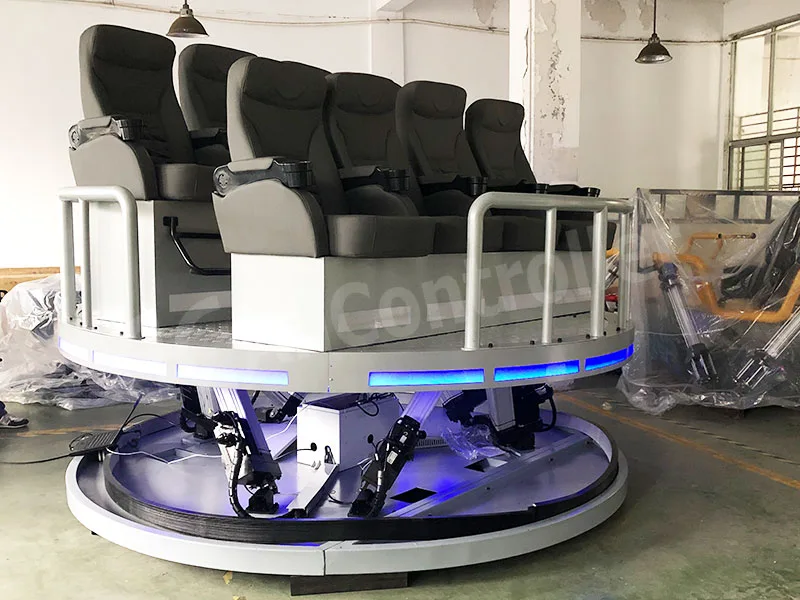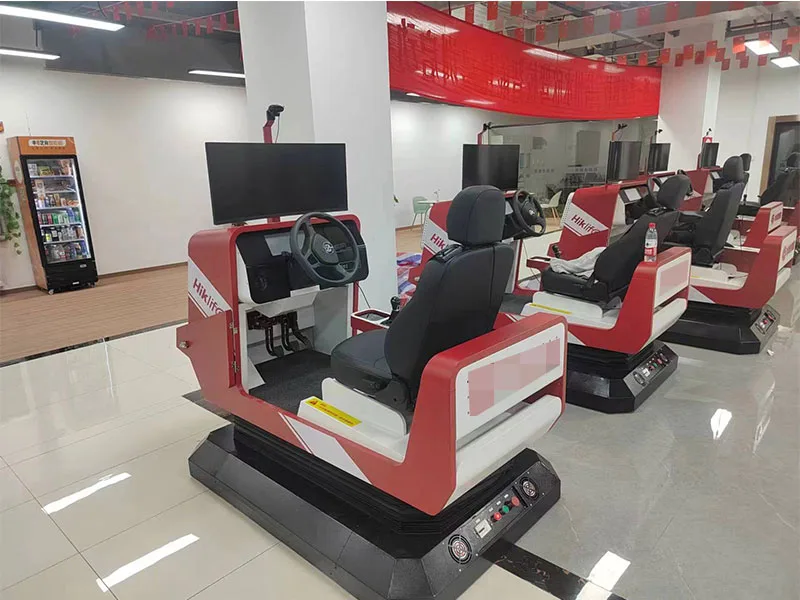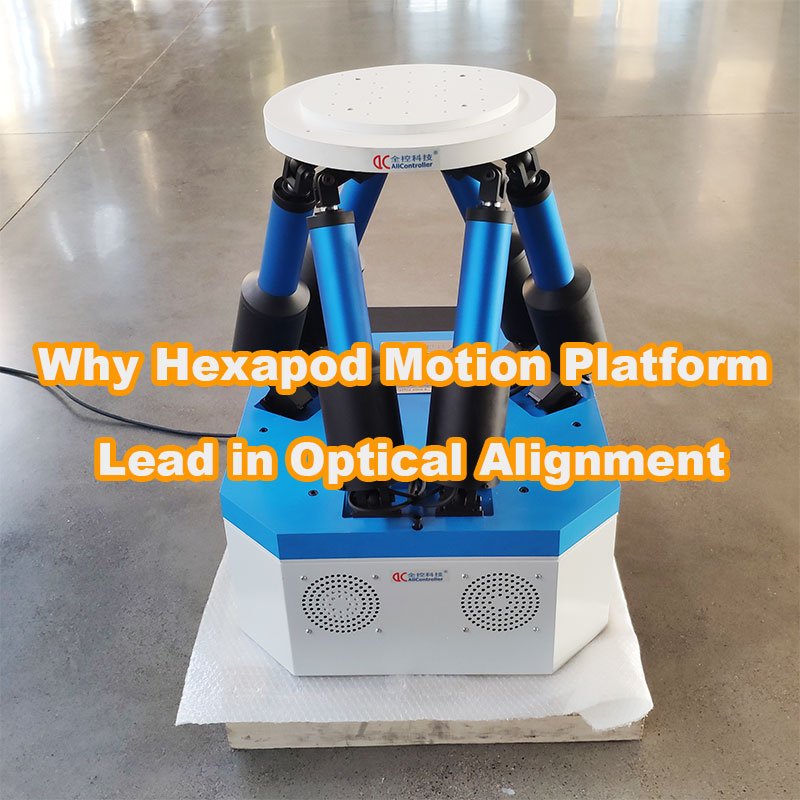
In the field of photonics, a hexapod motion platform is a six-degree-of-freedom (6DOF) parallel kinematics system that provides sub-micron positioning accuracy, high rigidity, and a programmable pivot point, making it the preferred solution for complex optical alignment tasks.
By utilizing six actuators working in parallel to support a single moving platform, the Hexapod motion platform eliminates the cumulative errors found in traditional stacked serial stages. This unique architecture allows engineers to achieve the extreme stability and nanometer-level resolution required for fiber coupling, lens positioning, and laser system calibration, where even a microscopic misalignment can lead to total signal loss.
Exactly what optical alignment needs when microns and arcseconds start deciding whether the beam couples or disappears.
Table of Contents
Optical alignment is a 6-DOF problem disguised as a 2-DOF task
Most people enter optical alignment thinking: “I just need X/Y.”
And yeah… the first hour feels like that. Then you see the real world: tiny wedge errors, lens decenter, fixture stress, thermal drift, cable forces—suddenly tilt and roll become the difference between “peak coupling” and “why is it getting worse when I nudge X?” That’s why many optical setups end up chasing up to six degrees of freedom with multiple stacked components.
One of my most painful commissioning memories was a fiber coupling station built on stacked stages: every “small improvement” in one axis subtly twisted another. We eventually got it working—but the tuning time was… let’s just say nobody wanted to repeat that week.
Hexapod motion platform don’t magically remove physics, but they reduce the “stacked wobble + cumulative alignment” trap by treating alignment as what it truly is: a coupled 6-DOF optimization problem.
The "Virtual Pivot Point": The Secret to Optical Precision
If you’ve ever tried to align a high-numerical-aperture lens using a stack of traditional stages, you know the frustration: every time you adjust the tilt, the center of your lens physically shifts in space. You end up in a “chase” where one adjustment ruins the previous three.
In my experience at Allcontroller, the 6DOF motion platform (Hexapod motion platform) solves this through a “Virtual Pivot Point.” Think of this as a software-defined center of rotation. We can tell the hexapod to rotate exactly around the focal point of a lens, even if that point is floating 50mm above the platform surface.
When the pivot point is aligned with the optical axis, the lens tilts without any lateral translation (parasitic movement). For an engineer, this turns a four-hour alignment “nightmare” into a five-minute automated routine.
What makes Hexapod motion platform uniquely suited to optical alignment
1. Compact stiffness that protects angular stability
Optical alignment is extremely sensitive to tiny angular errors. A compact parallel structure tends to deliver a strong stiffness-to-size profile because loads are shared through multiple legs rather than amplified through a tall mechanical stack. This is one reason precision Hexapod motion platform are used in demanding optical alignment and mirror positioning contexts where high resonant frequencies and fast settling matter.
In plain terms: fewer “mechanical elbows” flexing under you.
2. A programmable pivot point (center of rotation) that matches optical reality
In optics, you often want to rotate around a meaningful point:
the lens’ optical center,
a mirror’s reflective surface,
the fiber tip,
a system-defined reference plane.
Hexapod motion platform are widely described as enabling a user-programmable center of rotation for flexible alignment workflows.
In plain terms: you can “tilt without unintentionally sliding away” as much.
3. You get “all DOF” without building a tower of stages
Traditional optical alignment often stacks translation stages + tip/tilt + roll solutions to reach the required DOF, but vendors explicitly note that combining stacked components can add wobble and complexity, which multi-actuator kinematic stages aim to avoid.
In plain terms: one integrated mechanism is usually easier to keep stable than five bolted together.
4. Better alignment repeatability when the process is iterative (active alignment)
Optical manufacturing and assembly frequently run active alignment loops—move, measure image quality/coupling, iterate. Hexapod-based approaches are commonly highlighted for 6-DOF active optical alignment scenarios (especially lens/lens-group alignment).
In plain terms: if you’re doing “search + optimize,” the platform should behave predictably across those micro-moves.
Where Hexapod motion platform show up in optical alignment
You’ll typically see hexapod motion platform in applications like:
Fiber coupling / photonics packaging: aligning fiber to waveguides/devices where translation + angular DOF determine coupling efficiency.
Camera/lens module assembly: aligning lens elements along the optical axis and to each other for image quality, often framed as a 6-DOF requirement.
Telescope / large optics alignment: mirror positioning scenarios that prioritize stiffness, resonance, and settling.
Interferometry / CGH alignment: precision setups that explicitly call for a 6-DOF stage for alignment.
LiDAR Sensor Calibration: Ensuring the laser and receiver are perfectly co-axial.
Space-based Optics: Simulating the micro-vibrations and precision positioning required for satellite telescope mirrors.
Space-based Optics: Simulating the micro-vibrations and precision positioning required for satellite telescope mirrors.
Check out our motion platform application examples (https://motionplat.com/category/case/) and application videos (https://motionplat.com/motion-platform-video/)
Hexapod motion platform vs stacked stages for optics: the honest trade-offs
Hexapod motion platform are often the right answer—but not automatically. Here’s the practical comparison I’d use in an engineering review:
| Decision factor | Hexapod motion platform | Stacked stages (serial) |
|---|---|---|
| Angular stability under load | Often strong (compact parallel structure) | Depends; stack height adds compliance |
| 6-DOF alignment workflow | Native: integrated 6-DOF + programmable pivot | Achieved via stacking; can add wobble/complexity |
| Workspace shape | Coupled + non-rectangular (needs planning) | Easy to visualize (sum of axes) |
| Calibration complexity | Higher (kinematics + compensation) | Lower (axis-by-axis) |
| Long travel needs | Usually not the sweet spot | Often easier |
If your optical task is “pose control around a working point,” hexapods shine.
If you need long strokes and simple commissioning, stacked stages can still win.
Selection checklist: what you should specify before choosing a Hexapod motion platform
This is where projects either stay smooth… or become late-night tuning sessions.
Payload & geometry
Payload mass + inertia (rotation inertia matters as much as weight)
Center of gravity range (fixed vs swapped fixtures)
Metrology expectations
Do you need repeatability or absolute accuracy in space?
What’s the measurement method (camera MTF, interferometer, coupling power)?
Dynamic behavior
Required settling time at target error band (this is often the real KPI)
Environmental vibration and cable forces
Further reading: 2026 Selection Guide
Integration and control
Do you need a programmable pivot point for your optical workflow?
How will you define coordinates (mechanical datums vs optical datums)?
Who owns calibration/compensation and acceptance testing?
A common “works-in-the-lab-and-scales-to-production” approach is:
FAQ: Hexapod motion platform for Optical Alignment
What is the benefit of a Hexapod motion platform over a 3 DOF system in optics?
While a 3 DOF motion platform is excellent for simple tilt/heave tests, optics often require “Yaw” and “Lateral translation” to fully compensate for mechanical mounting tolerances. 6DOF gives you total control over the optical path.
How does payload affect optical alignment precision?
Unlike stacked stages, where the bottom stage can “sag” under weight, the hexapod’s parallel struts share the load. This means the accuracy remains remarkably consistent whether you are carrying a 10g fiber or a 10kg camera assembly.
Can a hexapod achieve millimeters resolution?
Yes. By using high-resolution electric linear actuators with piezo-driven or high-count encoders, Hexapod motion platform can achieve minimum incremental motions (MIM) as small as 0.1mm to 0.01mm.
How Allcontroller typically supports optical-alignment-grade hexapod builds
For optical alignment, the platform is only half the story. The other half is whether the control + calibration + mechanical interface helps you converge quickly and stay stable.
In most real projects, the differentiator becomes:
how the pivot/reference is implemented in software,
how calibration is handled (and how you verify it),
how stiffness and cable routing are protected in the mechanical design,
how acceptance tests are written so “performance” is measurable, not subjective.
If you want, you can give me your target use case (fiber coupling / lens assembly / mirror alignment / interferometer fixture) and I’ll tailor the spec language to what procurement and engineering teams actually approve.